1987 Cricket World Cup: The Reliance Cup, Final, Results
The 1987 Cricket World Cup, officially known as the Reliance World Cup, was a landmark event in international cricket. Jointly hosted by India and Pakistan from October 8 to November 8, 1987, it was the first men’s Cricket World Cup held outside England. The tournament also introduced the 50 over format, replacing the 60 over format used in the previous three editions.
Australia won its first World Cup title by defeating England by seven runs in a memorable final at Eden Gardens, Kolkata. The competition featured eight teams, closely contested group matches and outstanding individual performances from players such as David Boon, Craig McDermott and Graham Gooch. It also marked the beginning of Australia’s long period of success in the tournament.
Why Was the 1987 Cricket World Cup Called the Reliance Cup?
The 1987 Cricket World Cup was officially named the Reliance World Cup because Reliance Industries sponsored the competition. It was the fourth edition of the men’s Cricket World Cup and took place between October 8 and November 8, 1987.
India and Pakistan jointly hosted the event, making it the first World Cup staged outside England. The previous three editions, held in 1975, 1979 and 1983, had all taken place in England.
Eight teams participated in the tournament and were divided into two groups of four. Each team played the other three sides in its group twice, completing six group matches. The top two teams from each group qualified for the semi finals.
The tournament was an important moment for cricket in the subcontinent. Large crowds, growing television interest and commercial sponsorship demonstrated the sport’s expanding popularity beyond its traditional centres.
What Made the 1987 World Cup Different?
The Reliance Cup introduced several changes that influenced the future of One Day International cricket.
- First World Cup outside England: India and Pakistan became the first countries outside England to jointly host the men’s tournament.
- Introduction of 50 over matches: Earlier World Cups featured 60 overs per innings. The 1987 edition reduced the format to 50 overs, which became the standard for men’s ODI cricket.
- Joint hosting arrangement: Matches were played at venues across India and Pakistan.
- Commercial growth: Reliance Industries’ sponsorship reflected the increasing commercial value of international cricket.
- Australia’s first title: Australia won its first men’s Cricket World Cup, beginning a successful chapter in its tournament history.
The change from 60 to 50 overs was particularly important. It created a shorter match format that became the foundation of subsequent men’s ODI World Cups.
Teams and Groups in the 1987 Cricket World Cup
Eight teams competed in the Reliance Cup. They were divided into two groups, with each team playing six matches in the group stage.
| Group A | Group B |
|---|---|
| India | Pakistan |
| Australia | West Indies |
| New Zealand | England |
| Zimbabwe | Sri Lanka |
India and Australia progressed from Group A, while Pakistan and England qualified from Group B. The West Indies, winners of the first two World Cups in 1975 and 1979, finished third in Group B and missed the semi finals.
Zimbabwe and Sri Lanka also participated, representing the growing international reach of the game.
1987 Cricket World Cup Points Table
The group stage followed a double round robin format. Every team played the other three teams in its group twice. A win was worth four points, while a defeat carried no points.
Group A Points Table
| Team | Matches | Wins | Losses | Points |
|---|---|---|---|---|
| India | 6 | 5 | 1 | 20 |
| Australia | 6 | 5 | 1 | 20 |
| New Zealand | 6 | 2 | 4 | 8 |
| Zimbabwe | 6 | 0 | 6 | 0 |
Group B Points Table
| Team | Matches | Wins | Losses | Points |
|---|---|---|---|---|
| Pakistan | 6 | 5 | 1 | 20 |
| England | 6 | 4 | 2 | 16 |
| West Indies | 6 | 3 | 3 | 12 |
| Sri Lanka | 6 | 0 | 6 | 0 |
India and Australia finished level on 20 points in Group A, while Pakistan topped Group B with 20 points. England qualified alongside Pakistan after winning four of its six matches.
One of the most closely contested group matches was between India and Australia in Madras, where Australia secured a one run victory. The result was an early indication of how competitive the tournament would become.
1987 Cricket World Cup Semi Finals
The semi finals featured Australia against Pakistan and England against India. Australia and England won their respective matches to set up the tournament final.
Australia vs Pakistan: First Semi Final
The first semi final was played at Gaddafi Stadium in Lahore on November 4, 1987. Australia batted first and scored 267 for 8 in 50 overs. David Boon was among the leading contributors, scoring 65 runs.
Pakistan began its chase with the aim of reaching the target of 268. Javed Miandad scored 70, while captain Imran Khan added 58. Their partnership gave Pakistan a strong position, but Australia continued to take important wickets.
Craig McDermott produced a decisive bowling performance, taking five wickets for 44 runs. Pakistan was eventually bowled out for 249, giving Australia an 18 run victory and a place in the final.
McDermott received the Player of the Match award for his five wicket haul. The match also featured an important contribution from Steve Waugh, who scored 18 runs from Saleem Jaffar’s final over of Australia’s innings. Those runs proved significant because Australia’s eventual winning margin was exactly 18 runs.
England vs India: Second Semi Final
The second semi final took place at Wankhede Stadium in Bombay on November 5, 1987. England batted first and posted 254 for 6 in 50 overs.
Graham Gooch scored 115 runs, giving England a strong total. His innings was one of the defining batting performances of the knockout stage.
India attempted to chase the target but was bowled out for 219. Mohammad Azharuddin scored 64 and was among India’s leading contributors, but England’s bowling attack prevented the hosts from completing the chase.
England won by 35 runs and advanced to the final. The defeat ended India’s hopes of defending the title it had won in 1983.
1987 Cricket World Cup Final: Australia vs England
The final of the 1987 Cricket World Cup was played on November 8 at Eden Gardens in Calcutta, now Kolkata. Australia and England met in the final, with both teams aiming to win the trophy for the first time.
Australia had previously appeared in the 1975 final, while England had reached the final in 1979. Neither team had won the World Cup before the 1987 edition.
Australia’s First Innings
Australia batted first and scored 253 for 5 in 50 overs. David Boon played a crucial innings of 75 runs, providing the foundation for the Australian total.
Mike Veletta added an unbeaten 45 from just 31 balls. His late contribution helped Australia finish strongly and set England a target of 254.
Boon’s innings earned him the Player of the Match award. His ability to build a substantial score under pressure was one of the main reasons Australia posted a competitive total.
England’s Run Chase
England began the chase with a determined effort. Bill Athey scored 58, while captain Mike Gatting contributed 41 runs.
Gatting’s dismissal became one of the most memorable moments of the final. He attempted a reverse sweep against Australian captain Allan Border, but the shot resulted in a catch. His wicket changed the momentum of the chase and gave Australia an important advantage.
England needed 17 runs from the final over but could not reach the target. The team finished on 246 for 8, falling seven runs short.
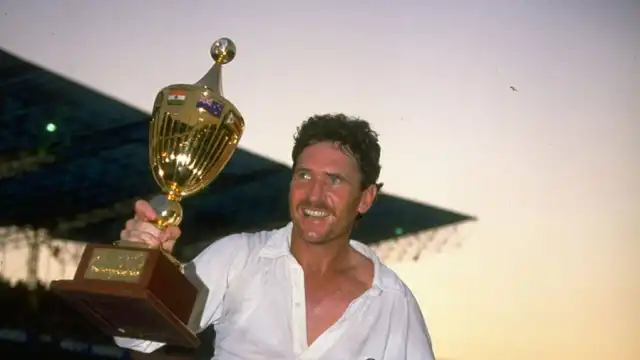
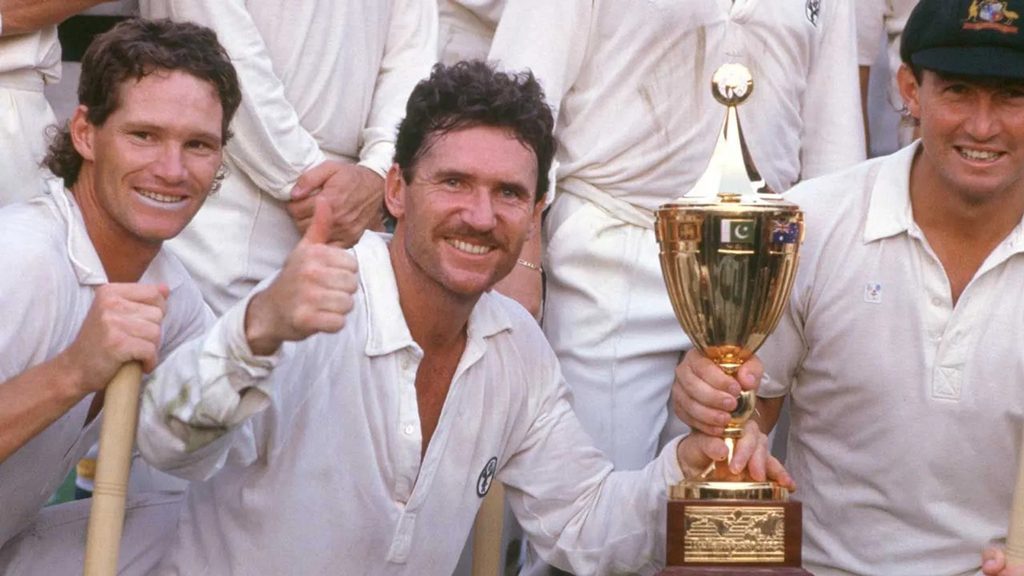
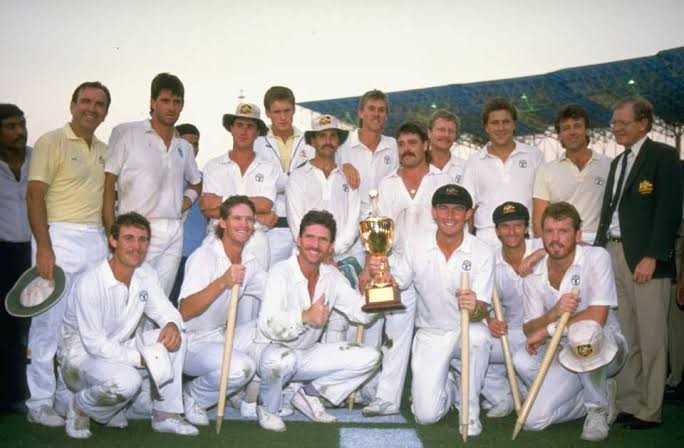
Australia won its first men’s Cricket World Cup title, and Allan Border became the first Australian captain to lift the trophy.
1987 Cricket World Cup Final Scorecard
| Final Detail | Result |
|---|---|
| Match | Australia vs England |
| Date | November 8, 1987 |
| Venue | Eden Gardens, Calcutta |
| Australia | 253/5 in 50 overs |
| England | 246/8 in 50 overs |
| Result | Australia won by 7 runs |
| Player of the Match | David Boon |
| Australian Captain | Allan Border |
| England Captain | Mike Gatting |
Key Players Who Shaped the Reliance Cup
Several players made important contributions during the 1987 Cricket World Cup. Some dominated the batting and bowling charts, while others delivered decisive performances in the knockout matches.
| Player | Team | Contribution |
|---|---|---|
| David Boon | Australia | Scored 75 in the final and won Player of the Match |
| Allan Border | Australia | Captained Australia to its first World Cup title |
| Craig McDermott | Australia | Took 18 wickets and finished as the leading wicket taker |
| Graham Gooch | England | Scored 471 tournament runs and made 115 in the semi final |
| Mike Gatting | England | Captained England in the final |
| Sunil Gavaskar | India | Played in his final international tournament |
| Kapil Dev | India | Captained India during the tournament |
| Imran Khan | Pakistan | Led Pakistan’s campaign to the semi finals |
| Javed Miandad | Pakistan | Scored 70 in the semi final against Australia |
Leading Run Scorer: Graham Gooch
Graham Gooch of England finished the tournament with 471 runs, making him the leading run scorer. His 115 against India in the semi final was particularly important because it helped England secure a place in the final.
Leading Wicket Taker: Craig McDermott
Craig McDermott finished the 1987 World Cup with 18 wickets, the highest tally in the tournament. His five wicket performance against Pakistan in the semi final was one of the most decisive bowling displays of the competition.
David Boon’s Match Winning Final Performance
David Boon’s 75 in the final against England provided Australia with the batting foundation it needed. His performance was recognised with the Player of the Match award and remains one of the defining individual efforts of the tournament.
Sunil Gavaskar’s Final International Tournament
The 1987 World Cup was Sunil Gavaskar’s final international tournament. He also scored his only ODI century during the competition, making an unbeaten 103 against New Zealand.
His century was an important individual achievement in India’s campaign, even though the defending champions did not reach the final.
How Did the 1987 World Cup Change Cricket?
The Reliance Cup influenced international cricket beyond Australia’s victory. It introduced a new match format, expanded the tournament’s reach and demonstrated the ability of the subcontinent to host a major global sporting event.
- Established the 50 over World Cup format: The tournament replaced the earlier 60 over format with 50 overs per innings. This became the standard structure for future men’s ODI World Cups.
- Expanded cricket’s international audience: Hosting the event in India and Pakistan brought the competition to large and enthusiastic crowds in the subcontinent.
- Strengthened commercial interest: Reliance Industries’ sponsorship highlighted the growing business opportunities associated with international cricket.
- Created a new champion: Australia’s victory marked the beginning of its World Cup success. The team went on to win the 1999, 2003, 2007, 2015 and 2023 editions as well.
- Demonstrated the value of joint hosting: India and Pakistan successfully shared responsibilities for a major international tournament.
The 1987 edition also showed that the Cricket World Cup could be successfully staged beyond England. The venues, crowds and commercial interest in India and Pakistan helped establish the subcontinent as an important destination for international cricket.
FAQs About the 1987 Cricket World Cup
Australia won the 1987 Cricket World Cup by defeating England by seven runs in the final at Eden Gardens, Kolkata. It was Australia’s first men’s World Cup title.
The tournament was officially called the Reliance World Cup because Reliance Industries sponsored the competition.
India and Pakistan jointly hosted the 1987 Cricket World Cup. It was the first men’s World Cup held outside England.
David Boon of Australia received the Player of the Match award after scoring 75 runs against England in the final.
Each innings consisted of 50 overs. It was the first men’s Cricket World Cup to use the 50 over format instead of 60 overs.
Conclusion
The 1987 Cricket World Cup was a landmark event that changed the direction of international one day cricket. Jointly hosted by India and Pakistan, the Reliance Cup was the first men’s World Cup outside England and introduced the 50 over format that became standard for future editions.
Australia’s seven run victory over England at Eden Gardens gave the team its first World Cup title. The tournament also produced memorable performances from David Boon, Craig McDermott, Graham Gooch and several other international stars. From Steve Waugh’s crucial semi final contribution to Sunil Gavaskar’s final international tournament, the 1987 edition remains an important chapter in cricket history.